Track your traffic without a cookie banner
What is cookie-less analytics?
A classic analytics tool like Google Analytics sets a persistent identifier in the visitor's browser to recognize them across visits — which triggers the consent-banner requirement under the ePrivacy directive. A cookie-less tool measures traffic without a persistent identifier: AELYNT computes a session hash derived from IP and user agent, recomputed and invalidated every day, never storing the raw IP address.
The problem
Many founders discover after the fact that installing Google Analytics forces them to show a consent banner, driving away some visitors before they even close it — just for a simple visit counter.
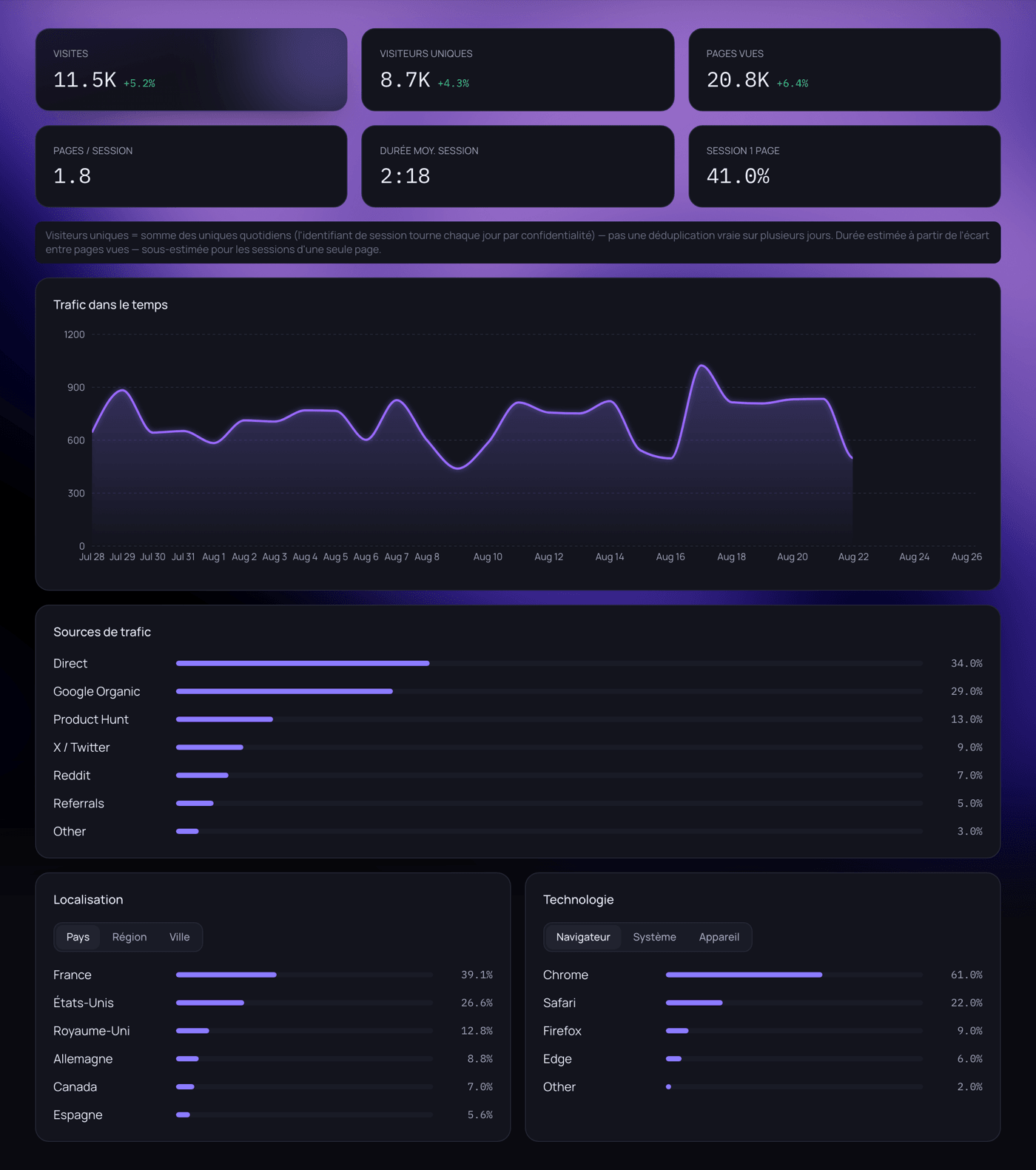
What you see
Visits, unique visitors, pageviews, pages per session, average session duration, and single-page session rate, with their trend over time. Below that: traffic sources, location by country, region and city, and technology — browser, OS, device.
Why these metrics matter
This choice has an honest trade-off: unique visitors sum daily uniques rather than deduplicating the same person across days, since the session identifier rotates daily by design. The number stays reliable for tracking a trend, less so for counting precise individuals long-term — a deliberate trade for having no persistent identifier at all.
How it connects
One script to add to your site's <head>. No tracking cookie is set for your visitors and no persistent identifier is kept — whether this tracking needs consent then depends on your context and the other tools on your site.
Frequently asked questions
Does AELYNT exempt me from a cookie banner?
The absence of a persistent identifier and tracking cookie places AELYNT's tracking outside the scope of non-essential cookie consent. This only covers this specific tracking — your site's overall GDPR compliance also depends on the other tools you use.
What happens to my IP address?
It's never stored: it's read when the event arrives, reduced to a country/region/city, then the raw value is discarded.
Can I exclude my own test traffic?
Yes, via a ?aelynt_ignore=1 parameter on your site, which sets a local technical cookie excluding your browser from the stats.