See where your visitors drop off before paying
What is a SaaS conversion funnel?
A conversion funnel splits a visitor's journey into steps — visit, signup, paid subscription — to measure the pass-through rate from one step to the next instead of a single overall rate. A funnel losing 90% of visitors before signup has an acquisition or value-proposition problem; one losing 80% between signup and payment has an activation or pricing problem — two very different problems a global rate can't distinguish.
The problem
An overall conversion rate ("1.5% of my visitors pay") doesn't tell you where to focus. Without a step-by-step breakdown, you often end up optimizing the wrong part of the journey.
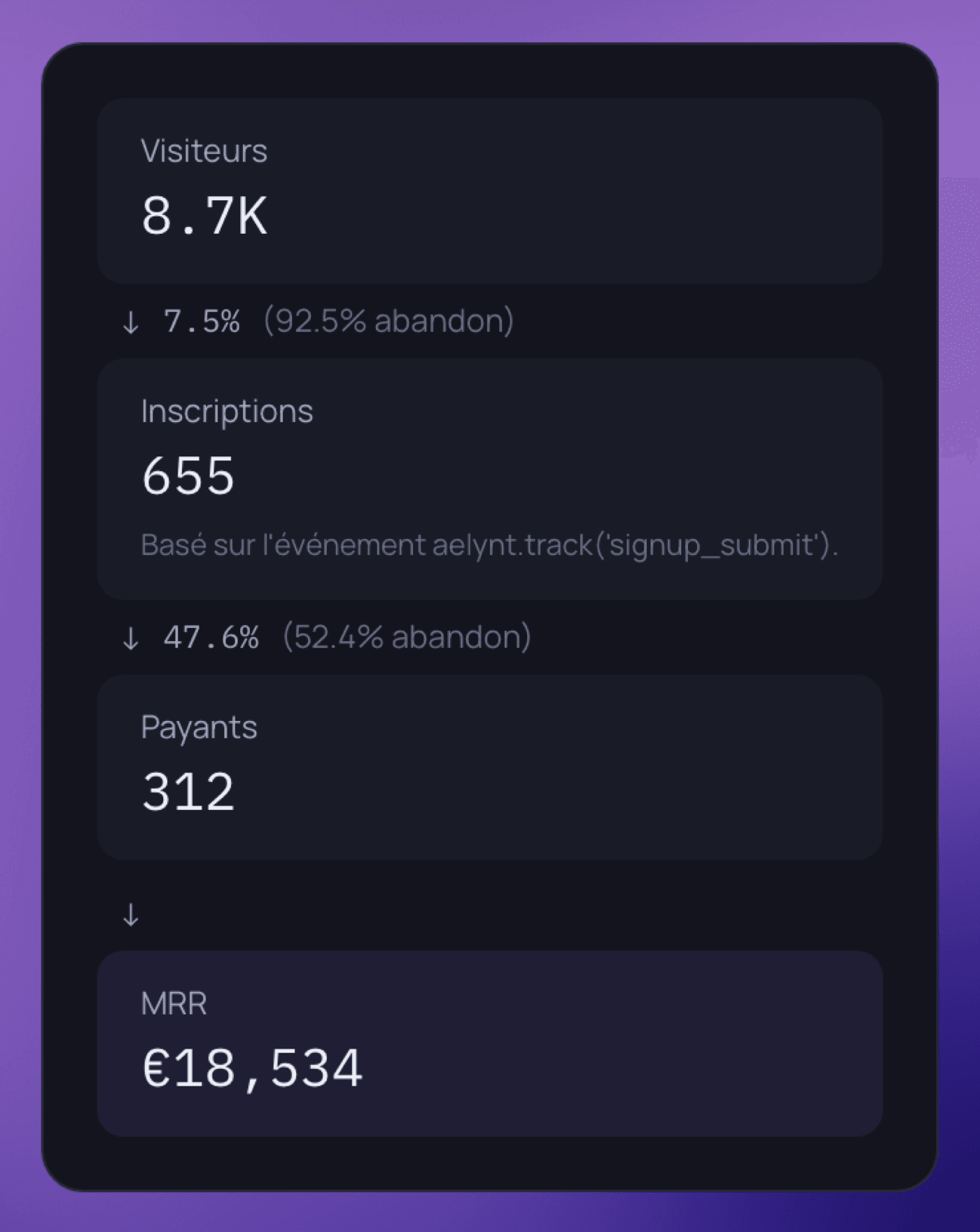
What you see
Three steps — visitors, signups, paying customers — with the pass-through rate and drop-off rate between each step, plus the MRR generated at the end of the journey.
Why these metrics matter
Comparing visitors → signups and signups → paying reveals whether the problem sits at the top of the funnel (few people sign up) or the bottom (signups don't convert) — two completely different levers to pull.
How it connects
By default, AELYNT approximates signups from new Stripe customers created in the period. For a precise measurement from the visit itself, instrument the aelynt.track('signup_submit') event on your signup form — AELYNT uses it automatically as soon as it's detected.
Frequently asked questions
What happens if I haven't set up the signup event?
AELYNT uses an honest approximation based on new Stripe customers instead of showing a made-up rate, and suggests configuring the event to refine the measurement.
Can I customize the funnel with my own steps?
Not today — the funnel shows the three steps: visitors, signups, and paying customers.
Over what period is the funnel calculated?
Over the period selected at the top of the page: 24h, 7 days, 30 days, 3 months, 12 months, or a custom range.